
Summer greetings!
As a Los Angeles area resident for more than 30 years now, I’ve seen lots of changes here in that time!
But of all the vibrant SoCal neighborhoods I’ve lived and played in, each with a character all its own, there’s one I hadn’t gotten around to visiting – even though I’ve always been intrigued by how times changed there. It’s a spot in the midst of the fancy Hancock Park district on what’s known as the Miracle Mile, and it offers a window back not only into LA’s history – but into its prehistory too.
That would be the La Brea Tar Pits! And what finally got me over to see them? Well, it was some highway decor a couple hundred miles to the north.
Okay, so I was heading up California’s Highway 99 to visit family when I drove beneath an overpass with artwork on it that looked like a herd of migrating elephants. Studying the next pass more carefully (as well as the traffic, of course), I realized by the enormous tusks on some that these must be depictions of mammoths!
The thing is I was going through Merced at the time – a city I’d always known as “The Gateway to Yosemite”. So why would there be pachyderm paintings on display there?
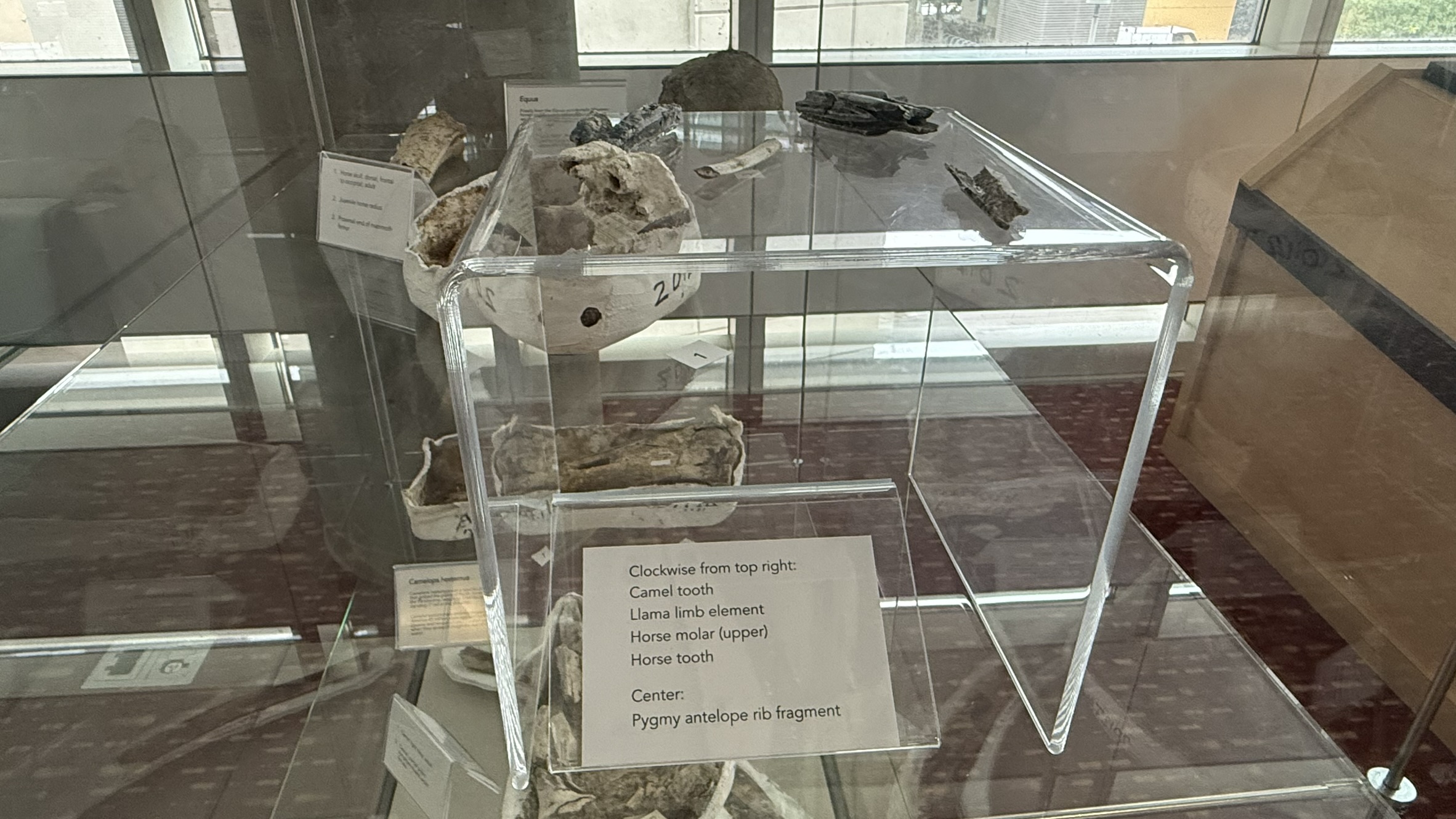
Turns out it’s because mammoth fossils – along with over 1,000 bones from other ancient animals – were discovered in 2012 during road construction just south of Merced! And solely because of those overpasses (well played, Caltrans – well played), I exited to check out a few Arboleda Fossils on display at UC Merced’s Kolligian Library!
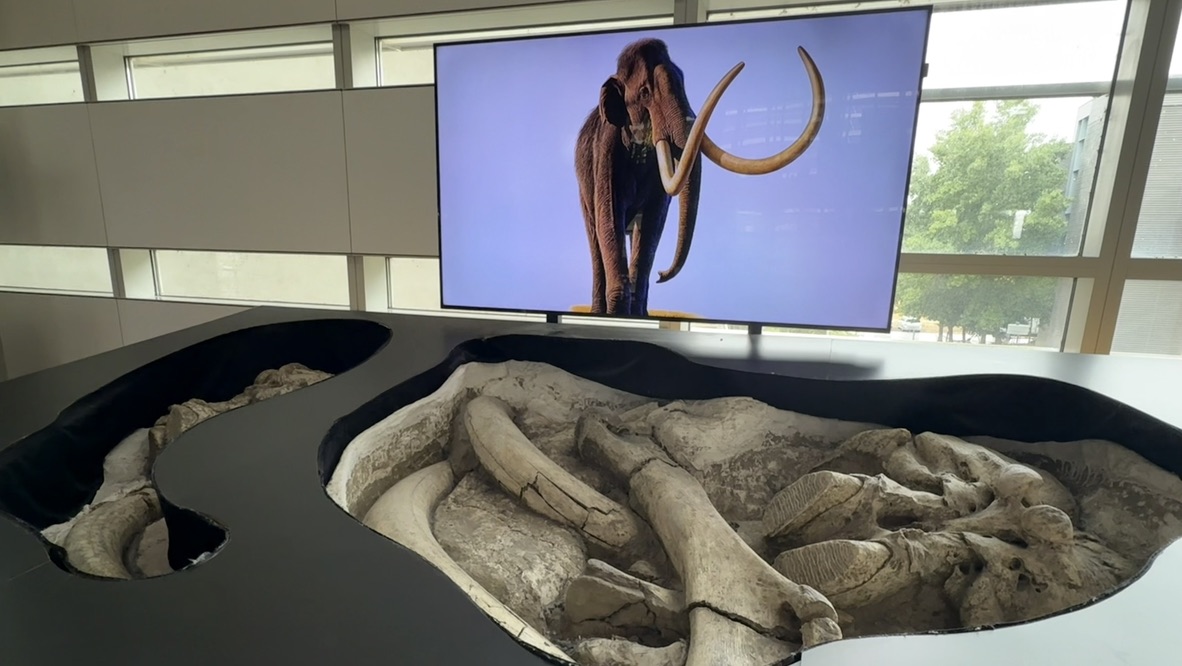
Seriously, in the morning these days, my creaky bones feel annoyingly old – but they have absolutely nothing on this collection! The Arboleda Fossils (named for the freeway project which unearthed them) come from the latter part of the Pleistocene Epoch – the era of Earth’s last big Ice Age. I consulted half a dozen sources for the proper time frame and, while I couldn’t quite get a consensus (in fairness, it’s not like these people were there), it seems like this era was roughly between 2 1/2 million and 11,700 years ago.
This was long after the age of the dinosaur, so many of the “megafauna” bones found were larger versions of familiar animals like camels, bison, wolves, horses, and the big ticket item – mammoths. Even an oversized sloth somehow slow walked its way from then into the present! Humans were around during this era too, and their hunting may have been responsible for the extinction of some of this big big game.
The fossil collection is technically owned by Caltrans, and more of it is on indefinite loan to view at the Merced County Library. Plus, if that’s not enough, there are even more bones and activities for kids at the Fossil Discovery Center in nearby Chowchilla.
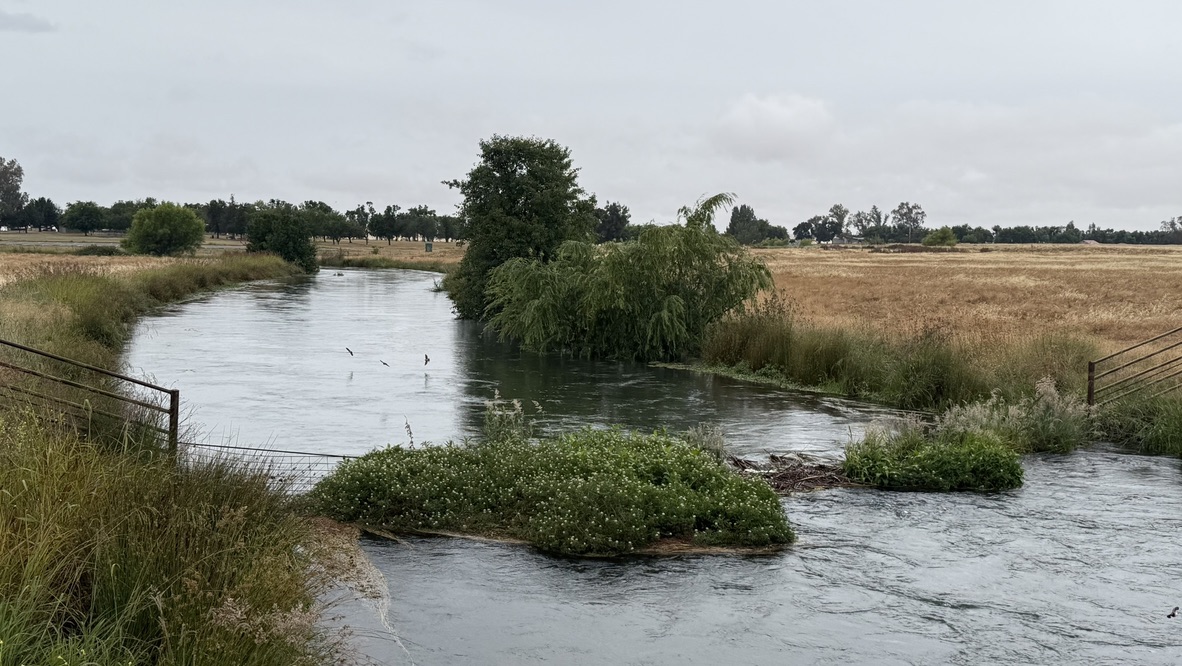
Looking out across the fields from UC Merced, I could pretty easily imagine this array of ancient wildlife roaming around. But I had a bit more trouble conjuring the same scene in LA:
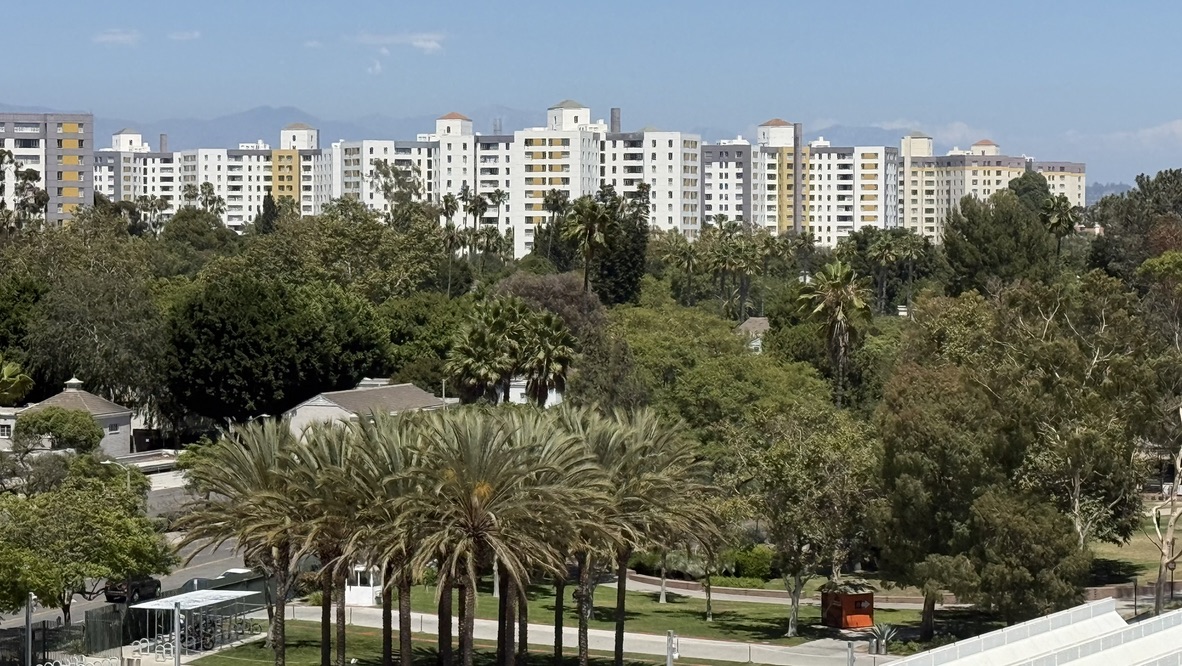
I’ve been aware of the La Brea Tar Pits & Museum since before I even lived in the area. They’re part of a fantastically eclectic concentration of museums along a few blocks of Wilshire Blvd., including the Los Angeles County Museum of Art (LACMA), the Petersen Automotive Museum and the Academy Museum of Motion Pictures! (Fossils, Fine Art, Ferraris, and Film – how could you go wrong?!)
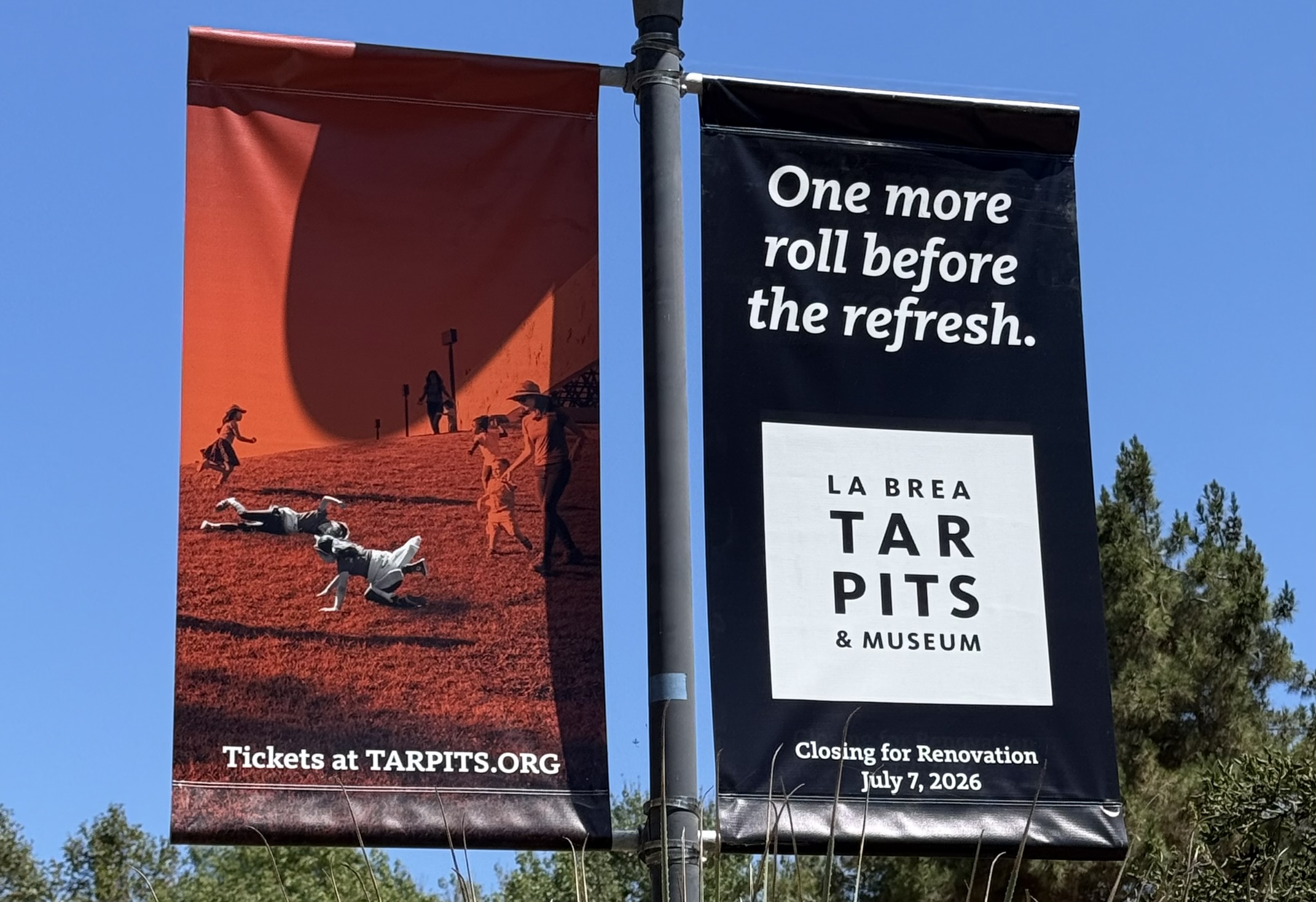
But it was seeing those bones in Merced that was the final push I needed to dive into the tar pits at home! (Annnd that would be a figurative dive.) Just in time too as the museum closes on July 7th for a two year renovation project. (Sorry – nothing like plugging something that won’t be open for a while…) Two years, though, isn’t even the quickest wink of an eye compared to the length of time that creatures were unknowingly giving their lives for paleontology right here!
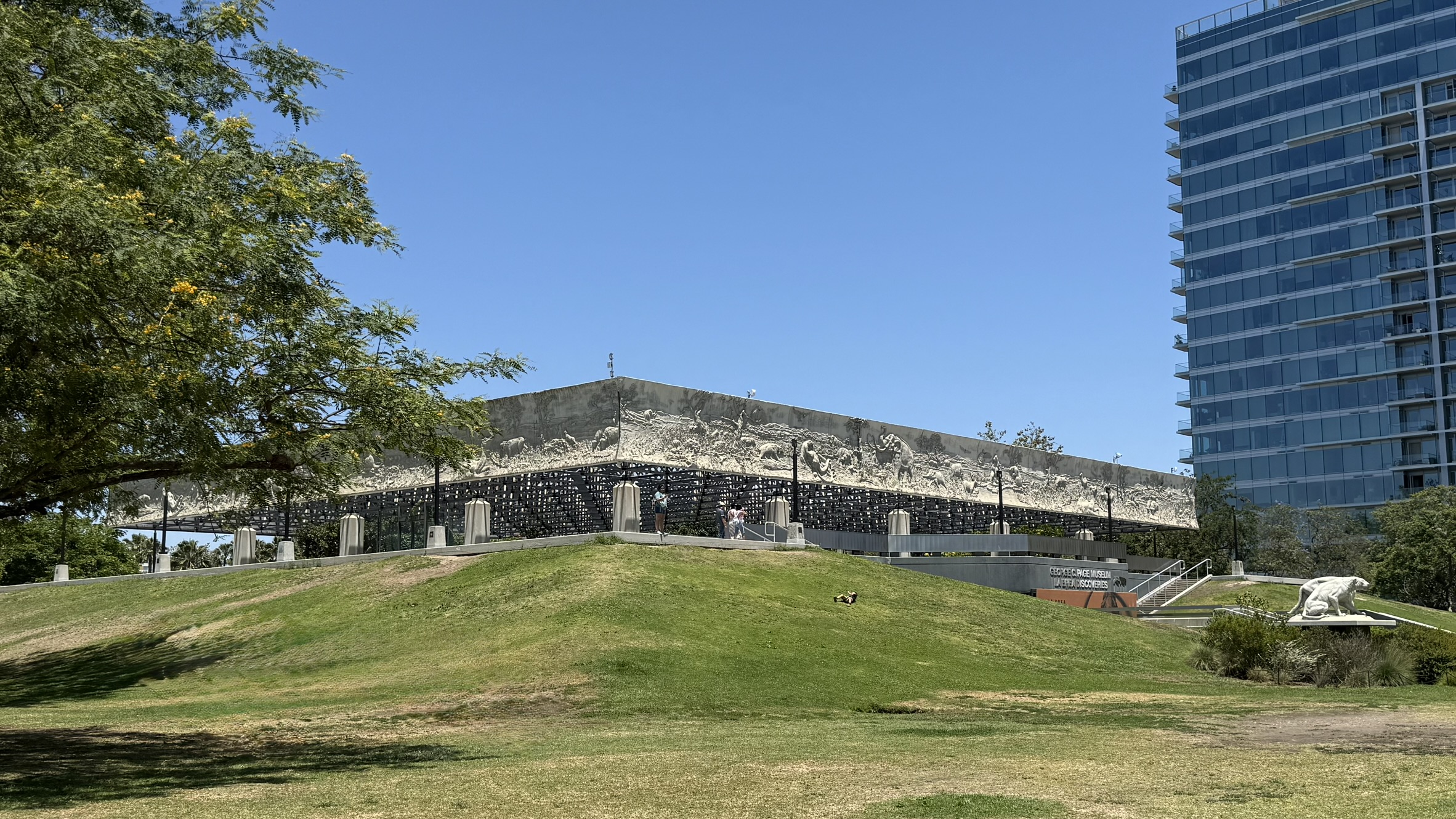
There’s a fee for the George C. Page Museum, but the grounds are free to wander – as well as to uphold a local tradition of rolling down its grassy hill! A really good way to shed the vibe of modern high-rises and manicured lawns is to gaze across the Lake Pit. It’s left over from the 1800’s when some Californians didn’t get the memo about gold, but were mining for asphalt instead!
Providing a hint of the oil field deep beneath, it’s actually asphalt rather than tar that’s been the sticky substance trapping animals from mammoths down to bugs (along with one ancient human) for thousands of years and leaving behind a treasure trove of bones. Bubbles that still gloop up to the surface of this little lake are caused mostly by methane gas, with hydrogen sulfide’s contributing a distinct – and not entirely pleasant – odor.
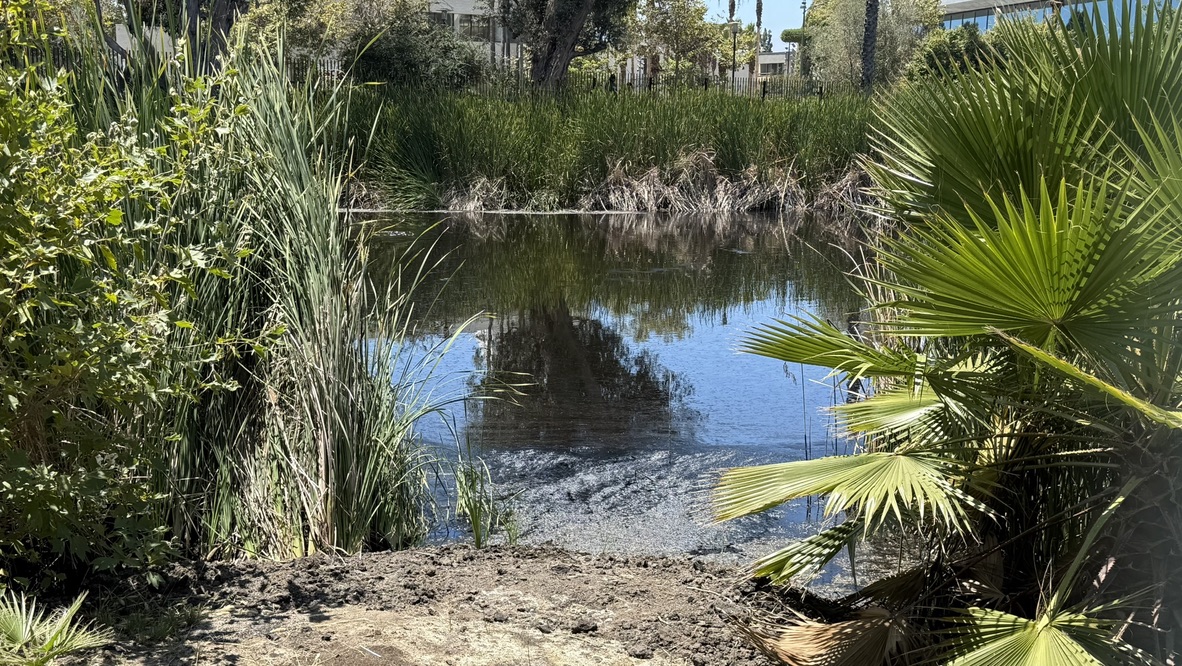
The fossils indicate that this natural version of fly paper was complicating animal lives at this Hollywood-adjacent site throughout a period from about 11,000 to 50,000 years ago. One animal might get stuck in the ooze which would attract others that then tried to feed on it – only to meet the same sort of Pit of Sarlacc-ish fate themselves.
And I thought showbiz was rough…
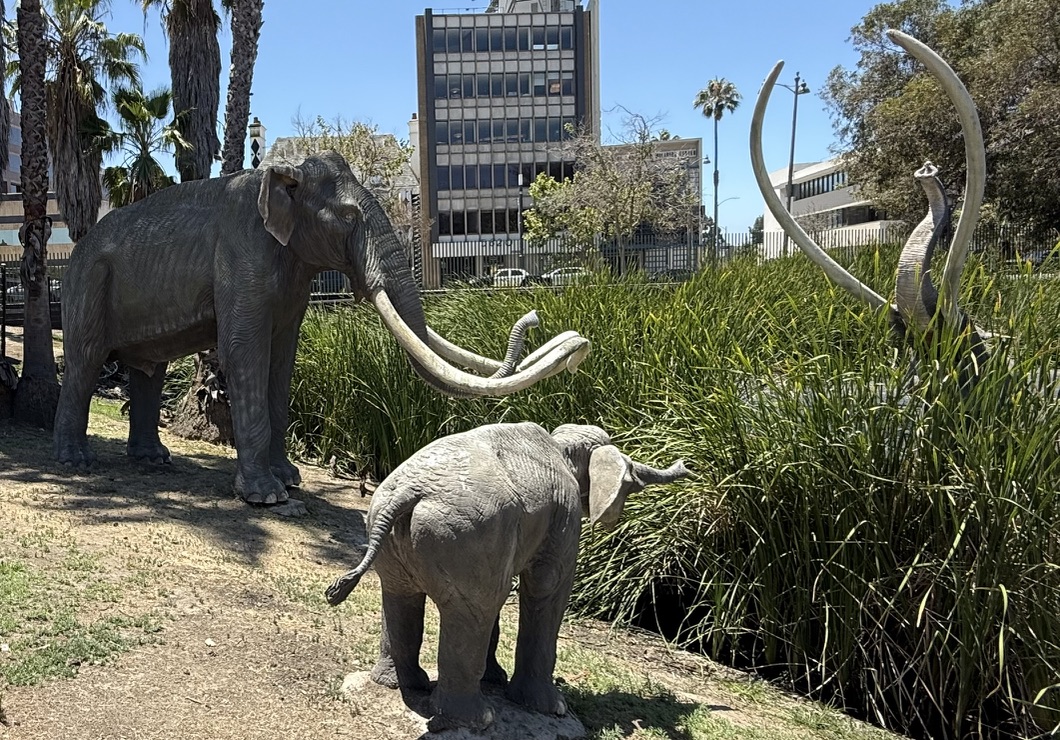
Excavations of the area began in the 1900’s and, as can be observed while strolling the park, they continue today and still produce finds!
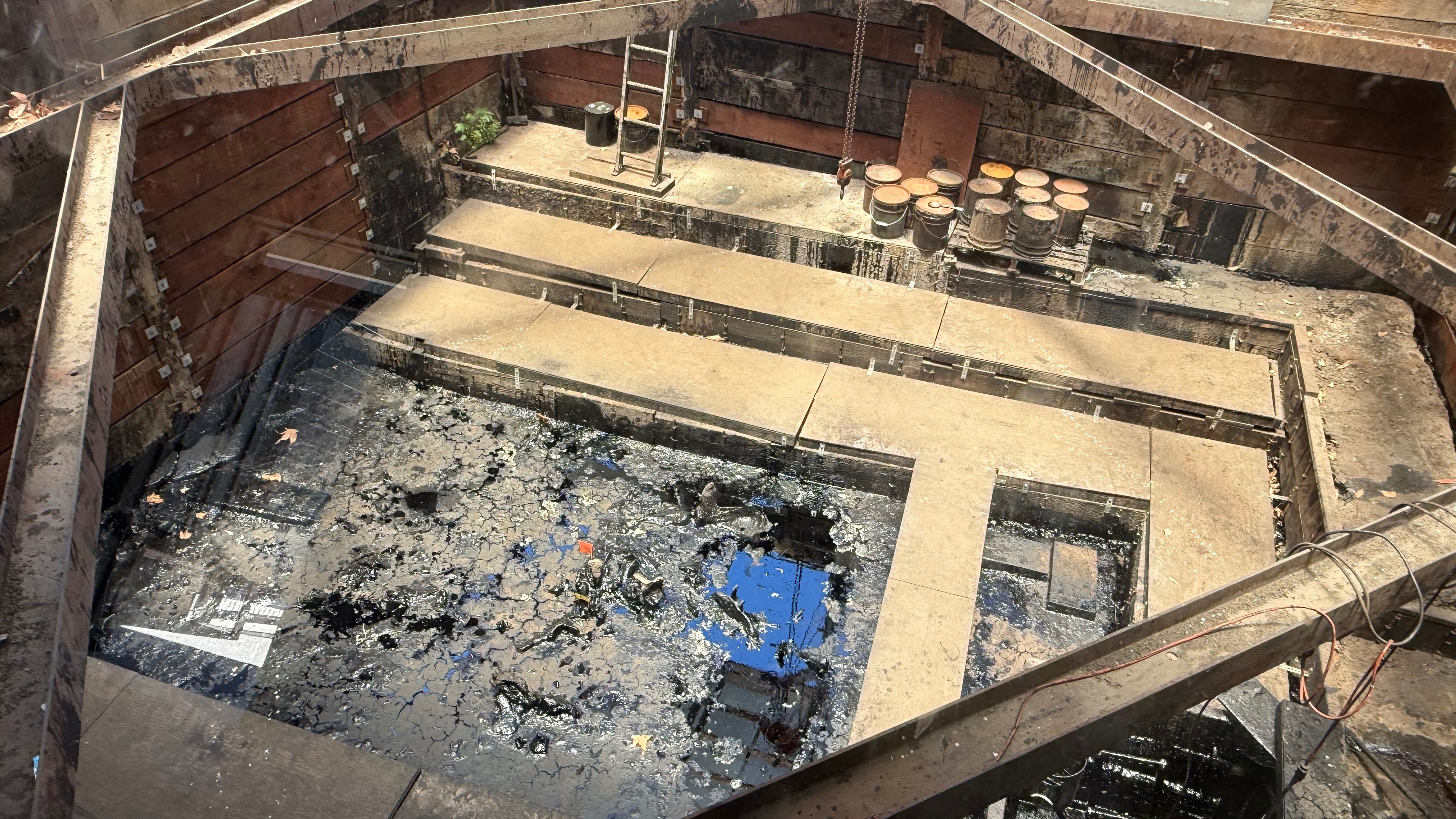
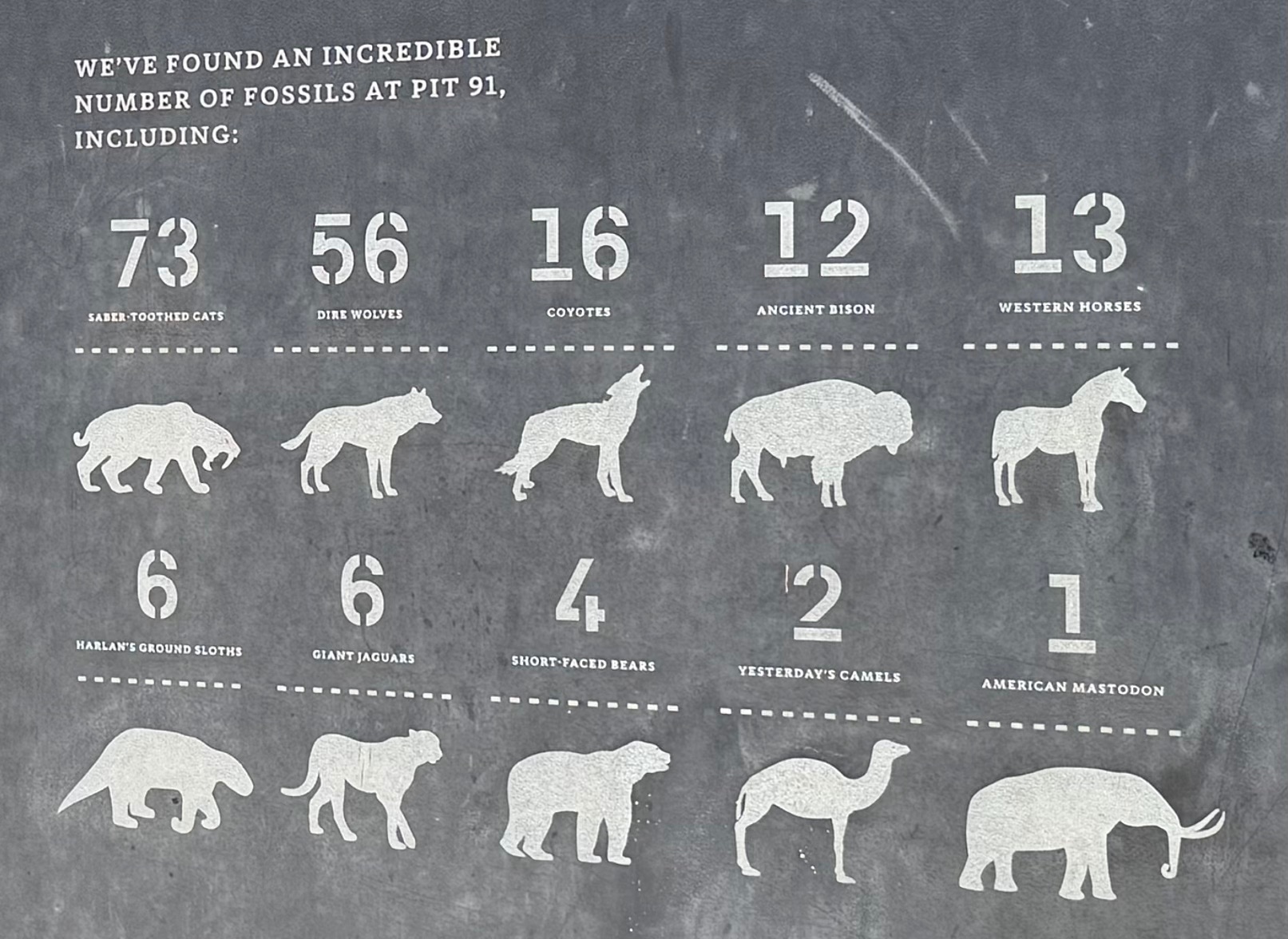
And then there’s the museum itself which serves up lots more prehistoric detail, plus incredible examples of the more than a million bones that have been discovered! I started my tour with a 3-D movie called “Titans of the Ice Age”, which was as thrillingly close as I care to come to meeting a mammoth. And while wandering the displays, visitors have the chance to observe volunteers and scientists in the Fossil Lab as they clean and conserve found fossils:
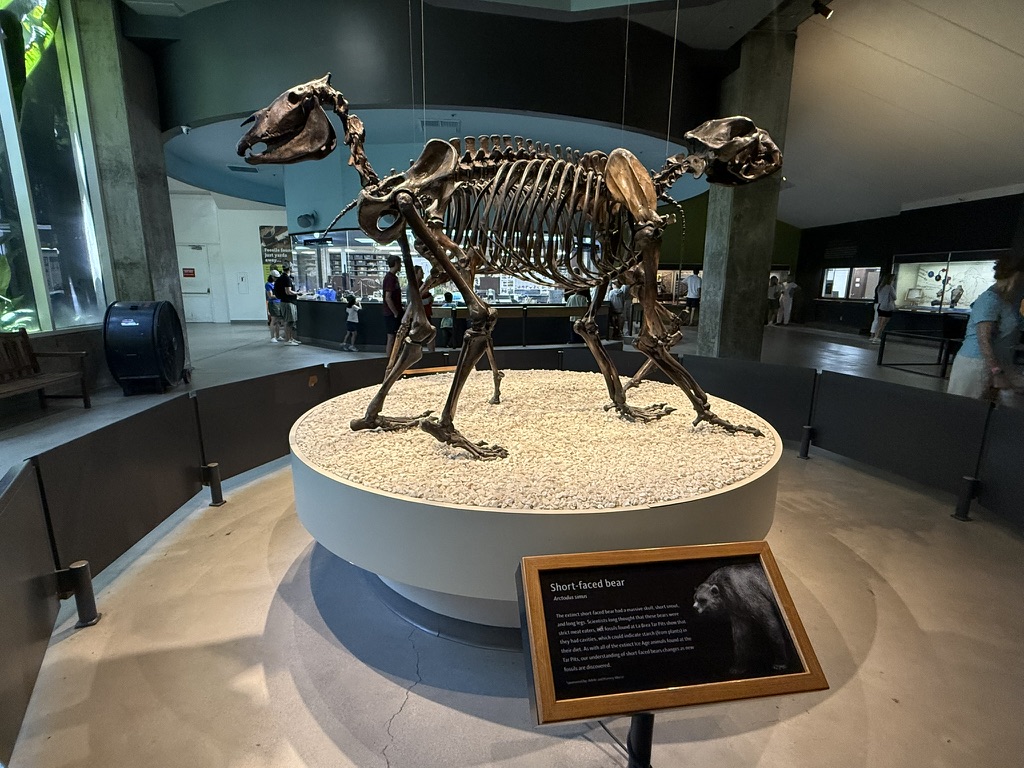
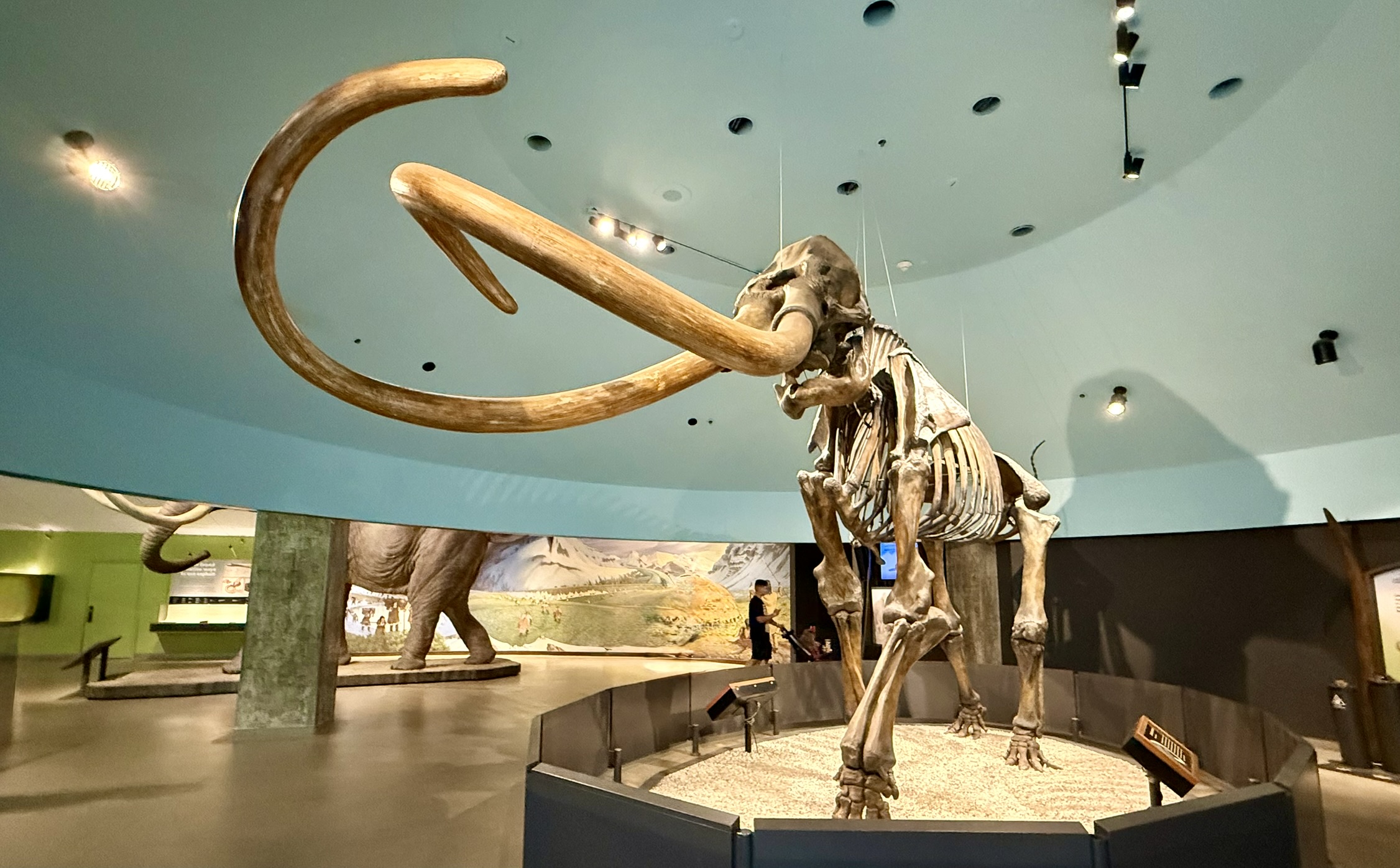
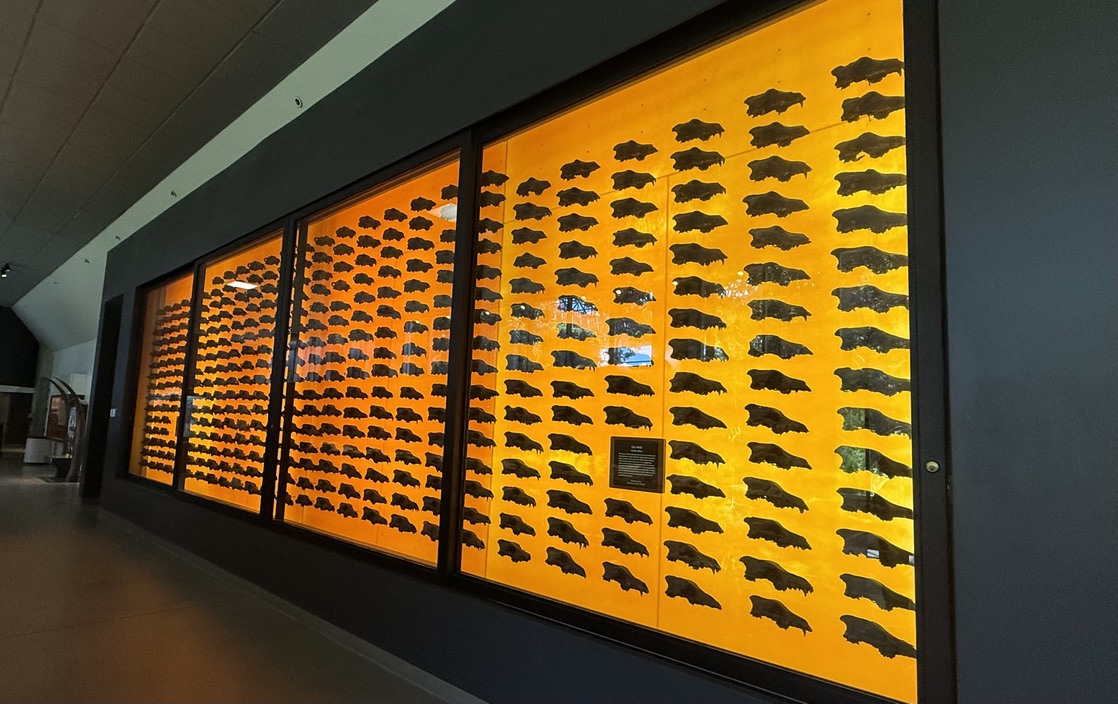
The top type of animal found here was the dire wolf – about 4,000 of them came and, like visitors to Hotel California, could never leave. Second place went to more than 2,000 saber-toothed cats; and coyotes came in third.
Now that I’ve broken the Ice Age ice for myself, I now know there’s much more cool stuff to see! Like I’ll try not to wait 30 years to get a look at the fossils housed at LA County’s Natural History Museum. Since LA was under water back in dinosaur days, that era is represented by an exhibit of nearly 40 creatures that swam the seas. And at Fossil Ridge Park in Sherman Oaks, it’d be fun to get a look at fossilized sea life left “in situ” among the rocky slabs.
I love that there’s so much evidence of ancient life for people yet to discover here in the Southland – and all over out there! I sure love too that delightful discoveries for myself can lie just a freeway overpass away!
As we enjoy the summer, I wish for you all sorts of exciting discoveries too! Also, forgive me but I can’t help mentioning that it’s important to keep our eyes on the road – and do keep an eye out for mammoths as well!
Cheers!


I cannot imagine the La Brea Tar Pits being in America. The old world yes. The new world no,
I agree – that’s why it’s always intrigued me. And it feels especially out of place to me in the heart of LA, but it’s quite cool!
But then again, I understand that the continents were once, a big mass of land. Lots of history and head scratching.🤔.
Yup – it does make sense. But it’s still mind blowing to me that these creatures were once in my own backyard!
Scary!
I’ve always thought that too. What is this ancient prehistoric pit doing oozing right in the middle of Tinseltown? But then it smacks me, history is so much more expansive than our limited grasp. We need the tar pits right there to remind us so. 🦕
How interesting! And fascinating.
Indeed! Can’t believe it took me 30 years to check it out!
The tar pits were an obligatory school field trip when I was growing up in LA back in the day. I still remember their distinctive smell (not bad, just distinctive). It says something that there are way more predator bones in the pits than those of their prey. I guess one giant mastodon meal was too big to miss. And I had no idea fossils had been found up in the Central Valley! The Valley was probably teeming with large critters before humans arrived for lunch…
That must’ve been a cool field trip! (Did you roll down the hill?) And yeah – looks like a lot of predators went after what they thought was an easy meal. Coyotes still lope around my neighborhood – didn’t realize they’d been cruising around here for so long… Thanks for reading!
I grew up in an L.A. suburb too, and saw the tar pits many times, but I forgot about their distinctive smell until you mentioned them, Vanmarmot.
That’s great! During the World Cup, I’ve been happy to see that some international visitors are taking that area in. And glad (I guess?) to bring back the sights – and aromas – of your youth!
;>)
Fascinating place, the museum and tar pits. Good for you that you were looking up and saw mammoths on the underpass, otherwise you might have missed this place
I just love when something unexpected like that comes up and all I have to do is follow my nose!
I remember begging my parents to go there when I was a kid in Glendale. We finally did. I don’t know what it is about those oil pits that causes procrastination! But it’s pretty cool. Now I’m intrigued about the fossils near Merced. Maybe one of these days…
Ha! Maybe we figure “Hey, they’ve been there for thousands of years – they’ll be there a while a longer!” 😃 And yeah – for some reason, mammoth fossils were the the last thing I expected in Central California!
I’m planning to get a museo kortti for my kid and myself soon. Out ticket to endless exploration. We’ll probably see more prehistoric elk than sabre-tooth tigers though. Museums are fabulous places for learning and one is never too old to explore.
Ah – a “museum card”, I believe? I’ve been lucky to visit Finland twice and very much enjoyed checking out its museums and natural wonders! Driving around with my folks, my Dad would call the roadside symbol indicating a nearby point of interest a “squiggle square”, and we loved pulling over to check it out! Kiitos and wishes on your exploring!
It’s actually a basic shield knot or looped square. In Finland it’s called Hannunvaakuna. I have one tattooed on my wrist. It’s supposed to protect from evil spirits etc Well, I didn’t know it was the Finnish museum association symbol then 🤣
Oh wow! Had no idea of the meaning behind it! And that tattoo should get you into any museum for life! 😃 Really appreciate your solving the mystery of the “squiggle square” for me – kiitos paljon!!
That would be “best” wishes, actually! 😃