

Springtime greetings! Just got back from a really refreshing getaway in Northern California! I decided to take my time on the trip and drive up from LA on Highway 101 which runs through California and on to Oregon and Washington. It even took me across the glorious Golden Gate Bridge!
Fellow Angelenos know our local stretch of it as the “Hollywood Freeway” or “The 101″. (Yeah, those skeweringly funny SNL sketches with “The Californians” are tough but fair – we do tend to talk a lot about driving routes and preface every freeway reference with “the”…) As I was cruising along with my keener “travel mode” observational eye, I kept noticing those commemorative bells along the road – which reminded me that a lengthy portion of…of…(nope – can’t not say it…) the 101 is also known by a historic name that evokes different feelings for different people –
It’s El Camino Real.
That’s Spanish for “The Royal Road” – and the bells mark this former 600-odd-mile lifeline between the missions, towns and garrisons that dotted the western coast and which were meant to solidify Spain’s onetime hold on “Alta California”. The bell idea started over a century ago with the ladies of the California Federation of Women’s Clubs, and the results of their Mission mission pop up like Easter eggs even in the heart of LA:
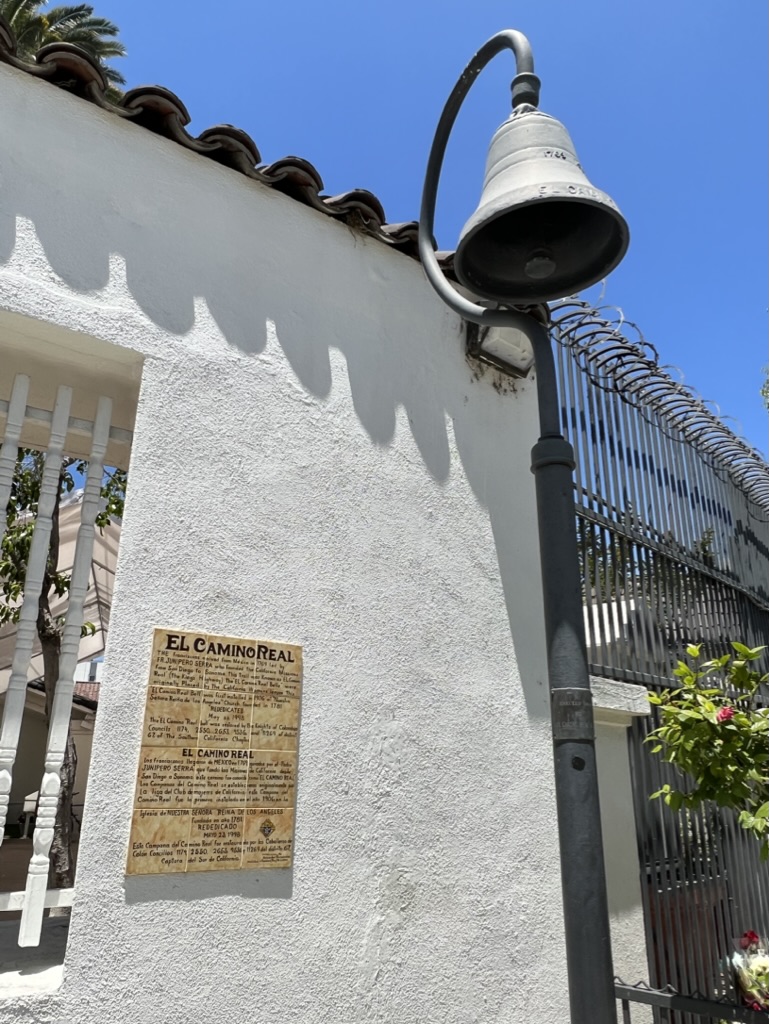

Lots of California school kids learn about missions as part of the fourth grade curriculum. I imagine other parts of the country have region-related studies of their own. And there can be different holidays too – like some of the more easterly states have one to honor the Revolutionary battles of Lexington, Concord and Menotomy (so that shot may have been heard round the world, but the vacation calendar was not).
A few years before those battles, Father Junípero Serra was getting the mission ball rolling here in the west with the 1769 founding of a mission in what would become San Diego. Of the 21 California missions that went up over a period of 54 years and which were largely restored around the 20th century, I’ve visited a succession of four. With all kinds of respect, I kinda think I’ve got the general gist of them now – but I did find that each of these four had its own unique charms!
Like the special feature of Mission Santa Barbara is that it has not one but two matching bell towers. For me though, the big selling point of this 1786 edifice (as if its tidy and tranquil curb appeal weren’t enough) is that it graces a hill overlooking the beautiful Pacific Ocean!

While I’m not covering the four Spanish army garrisons along El Camino Real, I am gonna just mention nearby El Presidio de Santa Bárbara so I can include this pic of an eternally enthusiastic fellow tourist:

The next mission up as one follows the Royal Road north is Mission Santa Inés in Solvang! It’s situated slightly inland and off the 101 at another lovely and peaceful spot. When I’m able, I adore pausing here in my travels through the area – even if I can’t decide whether to spell it Ines, Inés or Ynez…

Among the clashes of culture that occurred here back in the day, I’m betting the Franciscans wouldn’t have predicted that some Denmark-inspired settlers would later move in next door and turn Solvang into a tourist haven for Scandinavian kitsch! (Come for the Mass – stay for the Æbleskivers!) But the serene and stately mission admirably holds its own.
Modern cities had mostly overtaken the other two missions on my tour. But the next one in the chain – La Purísima Mission State Historic Park in Lompoc – seemed to me to offer the best picture of mission life as a whole.

Established in 1787, a distinction of this mission (its name is a clue) is that the Virgin Mary claims the middle spot on the church’s ornate altar. A lack of congregational pews is authentic to the period when (according to a well-informed Park Ranger) local Chumash Native Americans would have sat on mats and been divided by gender to take in a service.

Buildings here are outfitted to show the kinds of work and accommodations that would have been necessary to keep a mission running:


And there’s no passing lane marked on it, but here’s part of the original El Camino Real going right through these impressive grounds:
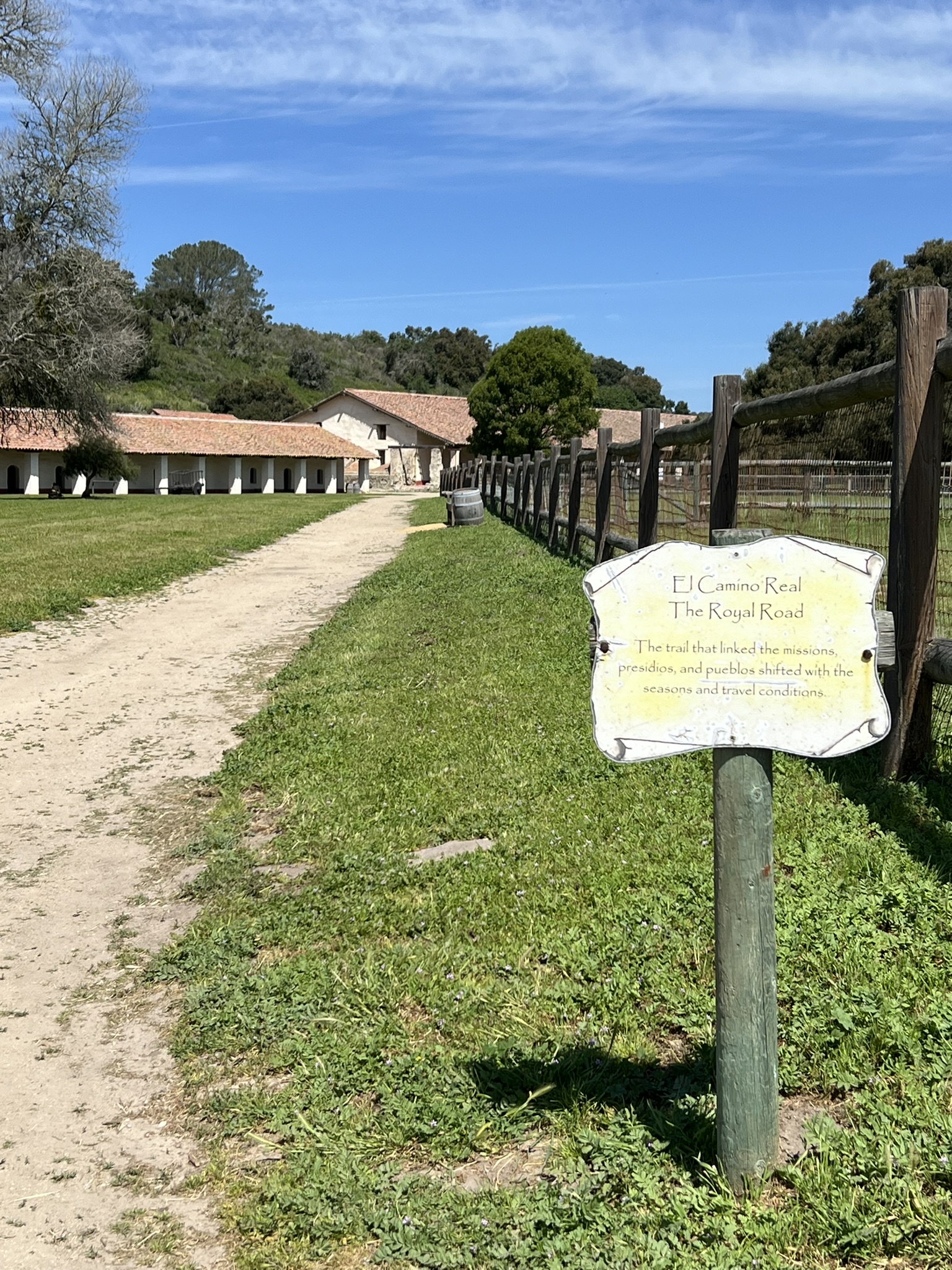
Another unique feature is La Purísima’s linear layout, as opposed to the more defendable quadrangle type. It didn’t serve the mission well in 1824 when the Chumash organized themselves to push back at the Spanish and Mexicans’ overrunning of their land and culture – this “Chumash revolt” was said eventually to have ended in reconciliation.
I almost bypassed the fourth and final site on my list when it looked like parking at Mission San Luis Obispo de Tolosa would have to be on a surrounding street. (Okay so I’m not proud of this, but I get intimidated sometimes by parking meters that I can’t just feed coins into anymore. And that’s even though I already figured out one other time how to pay for an entire afternoon of street parking with my credit card! It was on a meter for someone else’s space but, you know – baby steps…)
At any rate, I did end up stopping (and figuring out parking!) in the place that Spanish explorers first called La Cañada de Los Osos – “Valley of the Bears” – so dubbed because of its large population of grizzlies at the time. In 1772 when food for the four existing missions was scarce, an expedition returned to hunt the bears for meat, and the locale became the site of the fifth mission.

This one (another founded by Father Serra, himself) is now hemmed in by the town of San Luis Obispo – but inside the church with its magnificent timbers and brightly painted walls, it’s easy to feel transported to older times. While that long, thin design is now familiar to me, I discovered this church is unique for having a second nave running off to the right of the altar (where a practicing choir added atmosphere to my visit!). And I sure wasn’t surprised to see that the mission is well covered in the bell department:

I was very much moved too by the measure of balance offered through a fountain display in the plaza just outside – one that speaks of still older times:
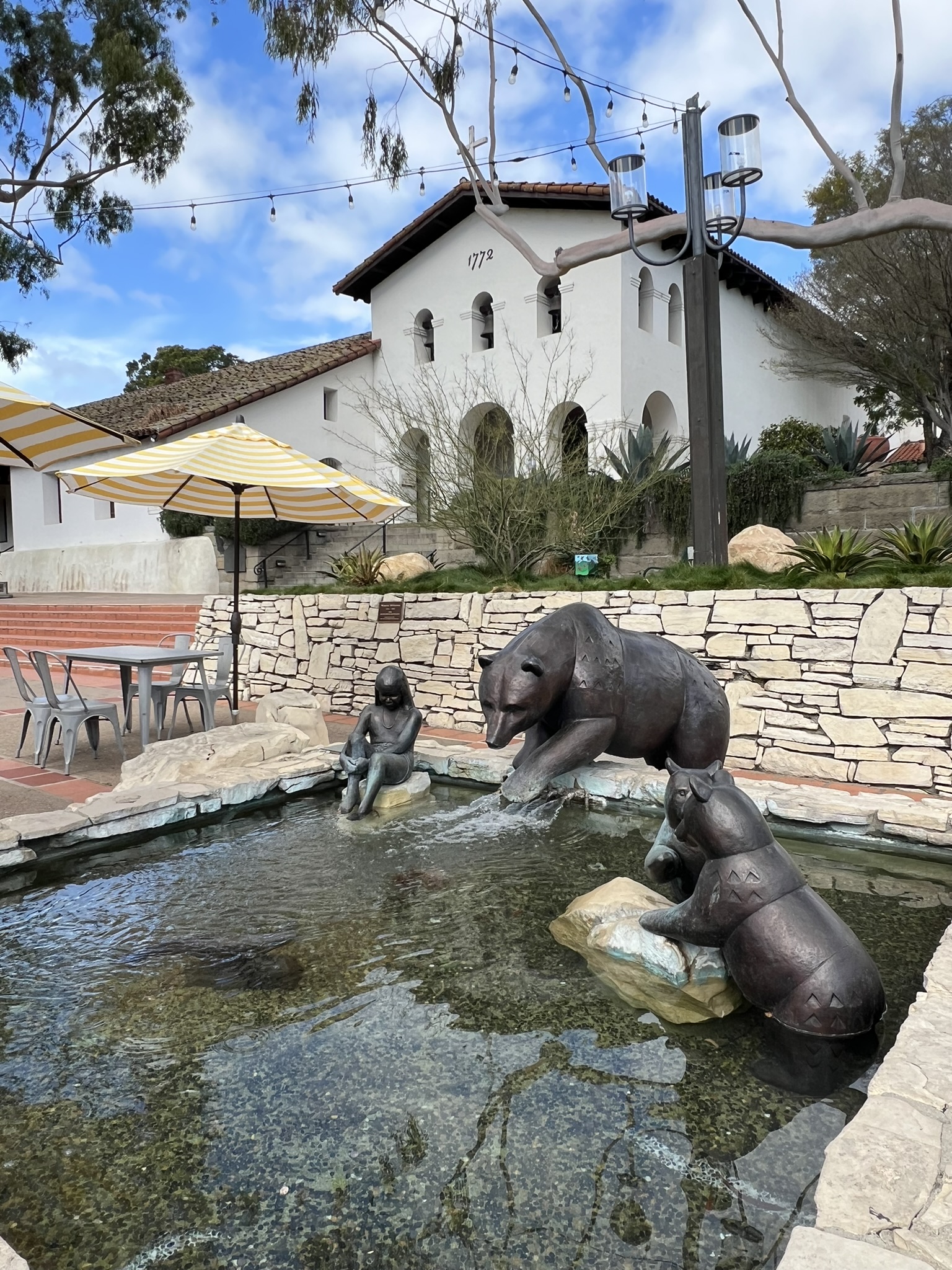
It’s hard to tell, but the child and the bear with its cubs are observing a steelhead in the water. Wish I could ask Dad whether he’d consider it more salmon-y or trout-y but, in any case, it’s a nice looking fish – even if in the context of the tableau, I’m thinking its days are numbered…
Although verrry far off now from being a fourth grader, I thoroughly enjoyed my lessons about the Mission days! I also appreciated the quiet coda of sitting beside that fountain – of letting it conjure the human and natural paths that existed in California long before El Camino Real, and even longer before my own kin arrived in search of gold.
Next time I head toward Solvang, I’m looking forward to stopping at the Santa Ynez Chumash Museum and Cultural Center which will be opening just down the road from the mission. Amid the nearby echo of those mission bells, I expect to hear more of the indigenous peoples’ California story, shared with me in a full voice.
And as far as tales about my home state go – I surely would be pleased to hear them all!
Cheers!

 TESSEROLOGY
very interesting post.
Thank you!
I was just driving on The Royal Road in beautiful Carlsbad. Thank you for adding some meaning to my errands searching for tacos, coffee, shaving cream, etc.!
Ha! I haven’t been on that part of the Royal Road in a while – hope you picked up everything you needed, and thanks for reading!
I can’t count the times I’ve driven 101 between LA and SF. Thanks for this trip down memory lane… 😊
Glad it brought back some memories, and thanks for reading!
Awesome-Ines! Beautiful photos and great information. This brings back memories; thank you:)
Thank you so much for reading!
This is so FUN! I feel like I’m touring with you.
Also want to add a lesson I learned when I moved from LA to SF. In SoCal we say “the 405, the 101,” in the Bay Area there’s no “the” (and I get mocked for this frequently). Another quirk in our beautiful state! xoxo
Thank you, Kathleen! Yeah, that “the” really marks you as an Angeleno – it’s so ingrained now, I don’t think I could change if I wanted to! Thanks again for coming along on this tour!
Brings back memories! Growing up in SoCal, I learned about El Camino Royale and the California missions in grade school, and visited quite a few of them over the years.
Ah, thanks for more confirmation that missions are part of a California kid’s education – and thanks for reading!
If it was in your goal to capture the essence of these historical sites in your photos, then “mission” accomplished! Thank you for sharing these perspectives.
Aw thank YOU, Karen Z!
A lovely trip and an introduction for me to the mission trail and the bells.
Happy to have learned about them, myself, so I can introduce them! Thanks for reading!